


How To Tell A Compelling Brand Story To Earn Trust & Win Customers
What is Brand Storytelling All About?

Stories captivate us. 😲
They teach us about life, inspire imagination and ignite emotions within our hearts. 🤝
Stories are also powerful enough to do the same for businesses. 📊 📈
It’s no wonder so many companies today want to learn how to tell a compelling brand story.
When a business tells a story compellingly, they’re able to capture their brand’s personality and relate with their audience better.
This actually isn’t a new thing.
Thanks to the internet and social media, brand storytelling has seen a resurgence.
This is good news for businesses as brand stories can increase a brand’s perceived value by 64% 🤓 which doesn’t come as a surprise – Everyone loves a good story!
Just look at the cinemas, people are willing to pay and sit for 2 hours (if the movie is good). 🍿
Speaking of movies, did you know they are often better received than documentaries? Think of sci-fi movies like Interstellar and Dr. Who.
These movies pique people’s interest in space-time travel more than any Discovery Channel show. 🌎
Plus, they also bring a human aspect to the story more than documentaries.
The movie directors do this by cleverly making us fall in love with their characters and personalities. 🎭
In short: Stories are powerful enough to touch us on a personal level (a human level). That’s what makes them such a great branding tool.
The Benefits of Brand Storytelling & How It Helps You Win Customers

It’s easy to dismiss brand stories as a ‘nice-to-have’.
But honestly, there’s really more to it than you think. 💎
Whether your customers are B2B or B2C, they are, first and foremost, people. And people have feelings. When you empathise with your audience’s struggles, you’re acknowledging their feelings.
As such, when your customer begins to feel understood, this marks the beginning of a relationship between them and your brand. 🤝
This could lead to further things such as your customer interacting more with your brand or maybe even deciding to purchase your product.
So, what better way to tap into your audience’s emotions than through brand storytelling? 🙂
It’s the ultimate weapon every company should use to bring in more business – and having empathy in your stories can do that for your brand!
But empathy is only part of the puzzle. 🧩 Telling a genuine story is the other half of it.
When you tell a genuine brand story, there’s a good chance you will get your customers to trust you more. 👍
So, you shouldn’t make any false promises to your customers.
If you tell your customers your cotton shirt is made from Supima cotton, it cannot be any other kind of cotton when your customers receive it. 🙅♀️
If you promise them your cleaning products are toxic-free and safe for children, it has to ring true and doesn’t leave skin blisters.
Once your audience believes your story is genuine, their trust in your brand will grow.
They’ll feel you are reliable, trustworthy and you mean what you say. It almost feels like getting a special treatment from someone. 👍
Aside from that, compelling brand stories can increase brand awareness even for products as small as a razor blade! 🪒
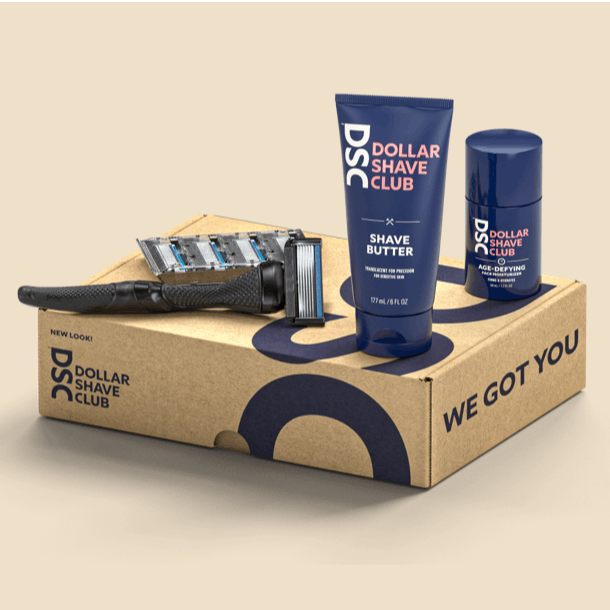
Back in 2016, the world was abuzz with Dollar Shave Club.
Picture credit: Dollar Shave Club
This indie brand made headlines when Unilever acquired it for USD 1 billion. 💵
No other men’s hygiene brand had garnered more attention than them by just selling razor blades using the subscription model.
Dollar Shave Club’s brand story was to disrupt the status quo of big razor blade brands like Gillette and Schick.
These brands used the razor and cartridge model and it makes their shaving products expensive. 😒
But Dollar Shave Club believed that shaving shouldn’t be expensive. So, they sold theirs for only USD 1 per month! 😱
Pairing their brand story with intensive social media marketing and viral video content, they generated a whooping USD 153.5 million in revenue by the end of 2015!
GoPro is another great example. Their brand story has helped them generate so many crazy amounts of leads.
Their story is all about capturing life from a fresh perspective. 🖼️
Whether it’s extreme sports or jumping off a cliff, GoPro makes it their cause to enable their customers to immortalise some of their life’s most exciting moments. 🙌

Picture credit: GoPro Facebook Page
Another good brand storyteller is Nike.
Nevermind those cool commercials of Michael Jordan slam-dunking in his Air Jordans. 🏀 👟 Those advertisements sell products.
Nike convinces their audience they are the brand of choice against Adidas and Puma by telling a story.
Their story is about pushing boundaries, whether it’s a fight against self-doubt and insecurities or pushing the limits of human capabilities. ✊
It is embedded in their commercials, posters, website, key opinion leaders, to their iconic tagline; ‘Just Do It’. And it resonates well with their audience.
Nike doesn’t just push product features and benefits. They aim to connect with people more often than not. 🤝
When Nike chose controversial athlete Colin Kaepernick to endorse one of their campaigns, the brand received some severe backlash and boycotts.
But their real core audience loved the campaign and approved of Nike’s move. ✔ 💯
Nike dared to take the risk because they understand their target audience and it fits their brand story; to push boundaries, do what you love, and dream crazy.
/s3.amazonaws.com/arc-wordpress-client-uploads/wweek/wp-content/uploads/2018/09/05192515/DmNYMlmWsAIbp8v.jpg-large.jpg)
Picture credit: wweek.com
One of Nike’s pride and joy, Serena Williams was also included in their Dream Crazy Campaign.
In this poster, Nike tells the story of a young Serena who hails from Compton, California. Her dream was to be the greatest tennis player of all time. 🎾
What is Nike trying to do here? They’re trying to tell you that if Serena can do it, you can too.
So, that’s how GoPro’s, Dollar Shave Club’s and Nike’s brand story appeals to their target audience who both agree and believe in what these three brands are doing. 💯
Each of these brands have a story that speaks to the interests and needs of their audience as they weave a narrative that possesses an interesting and relatable personality. 👍
We can tell you that if you aspire to be a premium brand, you need a good brand story. In truth, all brands should have a story. It’s a way to stand out in a marketing world filled with noise and competition. 🏁
It is getting harder for people to recognise a brand and even more complex to gain their interest and stay genuine.
A brand story can help you get their attention and gain their trust. 💪
So, the question remains – are you ready to take your brand to the next level?
If so, click here to talk to an expert about creating a brand story of your own. Your competitors have already started and grabbed your customer’s attention.
Will it be your brand story that wins customers next?
How To Tell A Compelling Brand Story?

If you’ve read this far, you’re probably dead serious on learning how to create your own brand story.
We’ll get to that in a bit. If this is your first time, we just want to reassure you that it’s okay to find this a bit daunting. 🙂
That’s why we’ll walk you through this one step at a time, so that you can craft a mindblowing story for your brand. Let’s begin!
This step is all about brainstorming which means you don’t have to worry if you come up with good or bad ideas. 💡
You can always filter the good from the bad ones later.
Right now, all you need is a story angle. So write down literally anything that comes to mind. ✍️
You can start with something easy like asking yourself what aspect of your brand do you want to turn into a story. 🤔 💭
Here are some helpful questions to consider when thinking of a story angle:
- What is your company’s mission?
- What motivated you to start your business?
- What is your vision for your company?
- How does your product help improve your customer’s lives?
- What positive reviews have your customers said about your products?
Don’t give up if you feel stuck. Go easy, and take simple steps.
Now, this step is a little tricky.
It’s tricky because many companies try to place their brand as the protagonist of their brand story.
If brands genuinely want to learn how to tell a compelling brand story, they should be shining the limelight on their audience as the main character. 🎭
It actually makes sense if you think about it. When watching a movie, many people enjoy imagining themselves as the protagonist of the story.
It’s quite rare for someone to imagine themselves as the supporting character or villain of the movie. 😈
We all want to be the star of the show – and so does your target audience. 🎯
So, let’s give them that!
“People will take action when they feel a unique connection with a person.” 🤝
Right now, you’re probably wondering where your brand fits into the story.
We’ll get to that in this step.
After identifying the protagonist, you need to identify the enabler of the story – the one who helps the protagonist progress/advance in the story. 🏃♂️
This is where your brand comes in. Your brand is the enabler who enables the protagonist (your audience) to overcome challenges and accomplish his mission.
Your brand is the Sam to Mr. Frodo. The Hermione Granger to Harry Potter. The Genie to Aladdin. 🧞
In the movies, Frodo would have died without Sam. 😵 Harry Potter would have been killed without Hermione. Aladdin wouldn’t have become a prince without Genie.
So, your role in the story is to enable the protagonist to progress in his journey. Without you, he will have a hard time.
So, you’ve already made your audience the protagonist and you’re the enabler. What’s next?
Every protagonist needs a goal or ambition they want to achieve. 🥅 So, let’s create one.
Here are some questions to consider when thinking of a goal/ambition for your protagonist:
- What are your audience’s passion, dreams and desires?
- Why do they want to achieve that dream or desire so badly?
- What would their life look like if they achieved their dreams?
After coming up with answers to these questions, your job is to weave these answers into your brand story.
Remember to prioritise your audience at the center of your story when you do this step.
The more you try to market your brand, the more you’ll subconsciously make the story all about yourself.
Have you seen The Lord of the Rings? Amazing movie, right?
What made it such a great movie? Adversity, challenges and drama.
The adversity faced by the characters in The Lord of the Rings was Sauron 🌋, the all-consuming evil, hellbent on destroying Middle-Earth. 🌎
Now, imagine if Sauron were no longer in the movie. Do you think it would still be as good a movie?
Well, we would surely still see Frodo, Sam and the hobbits. But we won’t see them going up against Sauron.
We’ll probably just see them leading their normal hobbit lives, doing gardening in The Shire, living happily in their cozy hobbit homes. 🛌 💤
There’s nothing challenging in this story – Sauron needs to be in the picture!
So, in this step, you need to make your story interesting by creating a source of conflict. You do that by touching on your audience’s pain points.
Put yourself in their shoes and ask yourself: “What problems do they face in their everyday life?” 🤔
Make a list of all their problems on a paper, and explain how your products or services can help them. ✍️
Remember, you’re the enabler, so address how your brand can help resolve your audience’s issues in the story.
Did you know when your customers buy your product, they’re also buying part of your brand story?
For this reason, it’s important to refine your story, as you are directly placing your story into the product itself.
When your audience is inspired by your story, it sparks emotions within them. From there, you’ll have a higher chance to get them to buy from you. 👍
Here’s a simple way to put it: People buy with their emotions, and supplement their reasons for buying with logic afterwards. 🧠
As such you need to carefully iron out any inconsistencies in your story, or any parts that don’t make sense until it becomes a compelling story.
If you’re still wondering how to tell a compelling brand story, feel free to hit us up on Facebook here or send us a message to ask for some further reading materials.
We would be more than happy to help out!
7 Types of Brand Storytelling Plots

Now that you’ve learned the basics of how to tell a compelling brand story, we’ll introduce you to a few common storytelling plots to give your story some depth.
Plots are highly essential in brand storytelling.
They help to shape your brand voice 🎤 and prevent you from telling a convoluted story.
You can use these 7 common storytelling plots below to learn how to tell a compelling brand story.
Once you’re done that, you’re already halfway there. The rest is just practise. 👍
Plot 1: Overcoming The Monster
This is a classic David vs Goliath story. ⚔️ Movies such as Star Wars, Rocky and James Bond are heavily based on this plot.
It is an underdog’s story where the protagonist is confronted by an evil larger than himself. 😈
To defeat this evil, the protagonist requires great strength and courage to destroy the monster.
If you choose to use this plot, you’ll need to make your protagonist’s journey seem difficult, fraught with danger and even the possibility of the protagonist’s defeat. 😵
But at the end of the plot, the monster will be defeated and your protagonist becomes well-respected and glorified. 💪
Brands who are comfortable sharing their failures can also use this plot to make themselves seem more relatable in the eyes of their audience.
Brand Story Case Study: ‘Overcoming the Monster’
A good Overcoming the Monster plot is Under Armour’s ‘I Will What I Want’ campaign where they casted Misty Copeland in this video. 📹
This video tells the story of American ballet dancer, Misty Copeland, who was told she didn’t have the right body and torso length for ballet. 🩰
When she entered the ballet world, she was also told she’s too old to be considered a candidate as an elite dancer. 💃
But she pushed aside the naysayers and showed the world that barriers are meant to be conquered.
Later, she emerged as a world-class ballerina. It’s an underdog’s story. 🙂
Plot 2: Rags to Riches
Rising from the ashes. 📈
This is a classic plot for movies like Slumdog Millionaire, Aladdin and Cinderella. 👠
It’s a tale about a poor protagonist becoming rich (a pauper becoming the prince story). 👑
Typically, the main character starts off with a tough life in the beginning, and he meets a ‘fairy godmother’ in the middle of the story who turns his life around for the better. 🧚♀️
Towards the end, he achieves success, gains a kingdom and gets the perfect life and wife.
For this story to work, you need to show your audience the hardship your protagonist endured. 💪
If you tell a straightforward narrative of easily becoming rich and successful, no one would care.
A true Rags to Riches plot focuses on what the protagonist has learned from the hardships they’ve endured along the way. 🏃♂️
Storytelling has to be relatable. That’s why hardships are a great way to push the story forward.
Brand Story Case Study: ‘Rags to Riches’
A classic Rags to Riches commercial is Johnnie Walker, the whiskey brand. 🍺
It tells the story of how a young ordinary Scottish grocer, John Walker, rose to global prominence.
Back then, most stores sold whiskies in the form of single malts whose quality varied from bottle to bottle.
Having a good head for business, John decided to start selling blended whiskies to offer his customers a more consistent product that is also consistent in quality.
Towards the end of the Industrial Revolution in 1857, John’s son, Alexander, took advantage of the boom in trade and engaged ship captains to introduce the brand around the world. 🌎
That’s how they became the brand we all know today.
Plot 3: The Quest
The Quest focuses on the search of a special item which the protagonist eventually finds in the end. 💎
It’s about the progression of the story from Point A to Point B. 🏃♂️
If you use this plot, you need to take your audience on a quest for discovery. Your protagonist has to travel far and wide in search of gold and treasures.
But along the way, he’ll meet other characters to aid him in his journey and he will also stumble across several challenges or obstacles. 🥴
There are dangers to overcome. Sacrifices have to be made. Difficult decisions to make.
Movies and stories like Lord of the Rings, Marvel’s Avengers trilogy and Mission Impossible are based around this plot. 🧙♂️
Why is this plot so captivating?
Well, it tells us that if we put our minds to something we can achieve the goal we set out for, and although there will be hardships, we will always have companionship and helpers to lift us up. 🤝
Brand Story Case Study: ‘The Quest’
TOMS // The TOMS Story from Giant Ant on Vimeo.
In this video, the founder of TOMS shoes, Blake Mycoskie, tells a story of how he established the brand.
It was founded with the aim of donating a pair of shoes to a poor child elsewhere in the world for every shoe he sold in his company. 👞
This idea struck Mycoskie after his visit to a remote village in Argentina. 🇦🇷 There, he witnessed poor children who couldn’t afford shoes and were walking around barefooted.
This was dangerous because of a deadly skin disease called podoconiosis which can be transmitted through soil. 🌱
Plot 4: Rebirth
Rebirth stories often revolve around the main character “falling under a dark spell” before breaking free and being redeemed.
It’s a story about renewal and reinvention.
To get this story right, you need to show your audience the ‘before and after’ effect of using your product.
It’s common to start the Rebirth plot with a tragic tone which later blossoms into a happy ending.
You can draw inspiration from some notable Rebirth movies such as: Sleeping Beauty, The Pursuit of Happyness and The Secret Life of Walter Mitty. 🍿
Here’s an example of how you use this plot.
Example: You are a shampoo company. You can start your brand story with a main character who has dry and flaky hair. But after using a magical solution (your product), their hair becomes silky and smooth again.
Brand Story Case Study: ‘Rebirth’
In this video called ‘Day One’ by Prudential, they touched on the topic of retirement.
Many retired people see it as the end of a chapter, but Prudential challenges that thought by suggesting it is merely the beginning of a new chapter, hence the name, ‘Day One’.
The story follows retirees across the country from their first day of retirement to paint a real and truthful picture to the 10,000 Americans retiring each day.
Plot 5: Voyage and Return
The Voyage and Return plot has some similarities to The Quest.
However, unlike The Quest, its main difference is that it doesn’t have the search element for a special item.
Another main difference is your protagonist may not return alive when embarking on their adventure in The Quest because the journey is filled with danger and perilous.
But in the Voyage and Return plot, your protagonist will surely return after their adventure.
Classic examples of the Voyage and Return plot include: The Wizard of Oz and Alice in Wonderland.
These stories share a common theme where the main character travels to another world where they feel trapped, threatened and overwhelmed.
But after they return to their own world, they develop new perspectives of life during their journey to the other world.
Using this plot is an excellent choice if you want to showcase how your brand stepped out of its comfort zone.
Brand Story Case Study: ‘Voyage and Return’
In this commercial from Corona (not the virus), the scene starts off with a man sitting at the beach with a Corona beer bottle in his hand.
Later, we see the scene shift back to him sitting on a plane with another woman (still with a Corona bottle in his hand).
The flight attendant asks the lady what she wants for a drink. She says she wants what the man is having – a Corona beer bottle. 🍺
Why is this a Voyage and Return story? 🤷♂️
It’s because although the man and woman are still on the plane, they have already ‘traveled to another world’ (the beach) in their minds with the help of Corona.
The story is implying that Corona makes life relaxing. 🏖️
Plot 6: Tragedy
This story plot uses elements of loss, hopelessness and tragedy to draw its audience into the story.
Tragedy is often used to tell customers to avoid doing something that has a negative or adverse effect on themselves such as smoking and gambling.
Feelings such as guilt, fear and regret are also commonly used to give the story a tone of sadness.
Stories such as Titanic and Romeo and Juliet are great examples of this plot line.
In this plot, the main character usually starts out as unhappy and unsuccessful. As the story progresses, he experiences unsustainable success, but later his success is taken away from him.
From that point, many more unfortunate events start happening in his life and eventually it leads to an extremely depressing outcome resulting in the main character’s death or ending up in jail.
Brand Story Case Study: ‘Tragedy’
This video from UNICEF tells the story of a 3 year old child named Marie from Congo who was suffering from malnutrition.
The doctors at UNICEF’s clinic tried to cure the child but they failed – Marie eventually died after 3 weeks in the clinic.
True to its name, the Tragedy plot line is exactly what it means. It starts with a bad beginning all the way to a worse ending.
This plot is not often used by commercial businesses, but works very well for charities and NGOs like UNICEF as it grabs their audience’s attention by showing them the reality and harshness of the world.
Plot 7: Comedy
Comedy takes humorous situations and creates an emotional connection so that your audience can laugh along with the story. 🎭
The key to telling a good comedy story is to keep things lighthearted and aim for a funny or happy ending.
It is stories like this that tickle your audience’s funny bone and it makes them so shareable! 👍
Great shows that are based on this plot include: How I Met Your Mother, The Big Bang Theory and Tom and Jerry.
So, it’s no surprise that comedy commercials often go viral! 😮
If you choose to use this plot in your brand story, you need to be 100% sure your audience finds your story funny.
Telling a joke that falls flat to the ground might cause the audience to cringe.
When done right, there’s a chance your audience might remember your brand for life. 😄
Don’t believe us?
Just take a look at the case study below, Old Spice. This brand is the living proof of great comedy!
Brand Story Case Study: ‘Comedy’
This Old Spice commercial cleverly combines both comedy and entertainment into one package.
In 2021, it has generated more than 58,000,000 views since the video was first published in 2010! 😮
If you’re not familiar with Old Spice, they’re an American brand that sells male grooming products such as: deodorants, body washes, shampoos and soaps.
They dominated the market in the 1930s, but since the 70s, they were perceived as a brand for old men. 👴🏼 Their sales plummeted for a very long time.
But then, this kickass commercial came in and refreshed the market’s image of Old Spice.
Thus, changing their image into a brand for youthful men – shoutout to Isaiah Mustafa!
Wrapping It Up…
With that said, you’ve reached the end of the article.
You have now learned how to tell a compelling brand story that earns trust and wins customers.
If you have any additional questions about branding? Feel free to drop us a message here if you’d like to chat more. 🙂